We followed to codes and conventions of documentary making, for more details, see earlier in my blog.
INTERVIEWEE NEVER LOOKS DIRECTLY INTO THE CAMERA
We followed professional standards by having the interviewee not look directly into the camera and to speak in full sentences so that the question asked could not be heard being posed.
MISE-EN-SCENE IS CONSIDERED IN EACH INTERVIEW
We considered the appropriate mise-enc-scene in all of our interviews. Notably in the home baker interviews we had a selection of cookery books, a jar of biscuits and a plate of home made biscuits on a saucer in the background, similar to other documentaries I have studies. Notably here in 'The Simpsons 20th Anniversary Special In 3d On Ice Part' The actress that plays Lisa Simpson has that character in the background.
OPENING TITLES
In documentaries that I have studied, they use an opening montage or titles that is relevant to the topic of the documentary. In our product, we used stock frame animation with biscuits and a Union Jack behind them, in 'In the Teeth of Jaws' They used a cartoon shark and ocean to relate to the movie 'Jaws'
As shown earlier in the blog John Frierson created the first documentary 'Housing Problems' where he defined the documentary as the 'creative treatment of Actuality' I believe that we have followed this throughout our work, notably in our opening credits, the use of stock frame animation, and the home baker section of the piece, where it is set out like a cookery show and the music is fits the mood and is entertaining.
We handed out questionnaire’s to people who watched our documentary, listened to our radio advert and saw our print advert and asked whether or not that they believed they were comparable to professional products.
The general answers were that they believed it to be informative and that it flowed. They found our voice over to be appropriate. They believed that we stayed true to the conventions of documentaries and that our print adverts were comparable to the professional channel 4 ones.
I uploaded our documentary to the social networking sight Facebook for my friends to give their feedback on.
From Facebook I learnt that Our documentary was generally enjoyed as people discussed how they found it interesting and that they could see we had considered our Mise-en-scene throughout. They also complimented our music choice as it was catchy, it also related to the documentary theme. However some commented that the sound quality could be consistent and be improved. Especially how the home baker's voice echoed. If we were to do this again we would use a boom mic so the sound would not echo. The Millie's Cookies interview was also picked up on as having poor quality sound. If we were to make the documentary again, we would have gone back to the store and re-filmed the interview and used a mic or a boom to improve the sound quality. Also, the music bed used was also commented on as being too loud in parts, so we would lower the volume if we were to make the documentary again.
This person was impressed that the vox pops were the same used in the radio advert, keeping consistency throughout the campaign. She was also impressed the voice over and music were the same. She commented on the variety of camera angles and considered mise-en-scene that related to the documentary theme. She also stated that the use of stock frame animation was relevant and with the music was catchy and entertaining. She also said that the use of graphics was simple, used in other documentaries. She also picked up on the quality of sound throughout, also we would definitely change the sound and re shoot some interviews using a mic or boom.
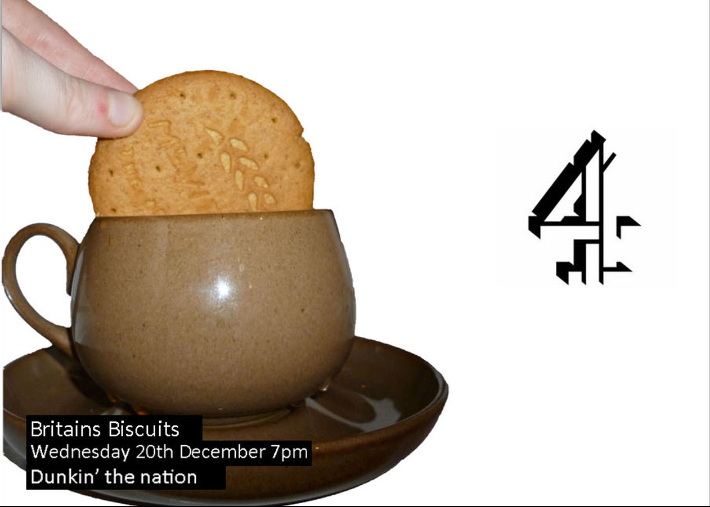
This person liked how we followed the codes and conventions of professional channel 4 print adverts by having the logo and strap line in the same place. She also commented on how the strap line was consistent with the one in the radio advert. However she did note that the central image, although was eye catching and related to the topic, you could see the camera's flash in the cup, so if we were to make another one, we would use a different image or perhaps use a camera without a flash.
This person enjoyed the music and found it to be catchy and entertaining and also enjoyed that, along with the narrator and the vox pops, was consistent with the documentary. She also commented on how strap line was the same in the print advert and how it was similar to professional standards as it was short and detailed relevant information such as the time and date the documentary will air. She did comment on the use of sound and how it was a little too loud in the begging. If we were to make a new radio advert, we would turn down the volume of the song at the beginning so that the narrator could be heard more clearly.
Audience Feedback is very important to us as it tells us whether or not we did a good job as a documentary maker. The good feedback lets us know what we did right and the negative feedback is as, if not more important. nNegative Feedback tells us what we did that needs to be improved, so if we were to make the documentary again, we could do to ensure that less negative feedback is given next time. Overall, the negative feedback was based on the changes and poor quality of sound. If we were to make the documentary again, we would use mics or booms in all interviews and change the volumne of the narration and/or music bed to ensure that the audience would hear clearly.
QUESTION FOUR
How did you use media technologies in the construction and research, planning and evaluation stages?
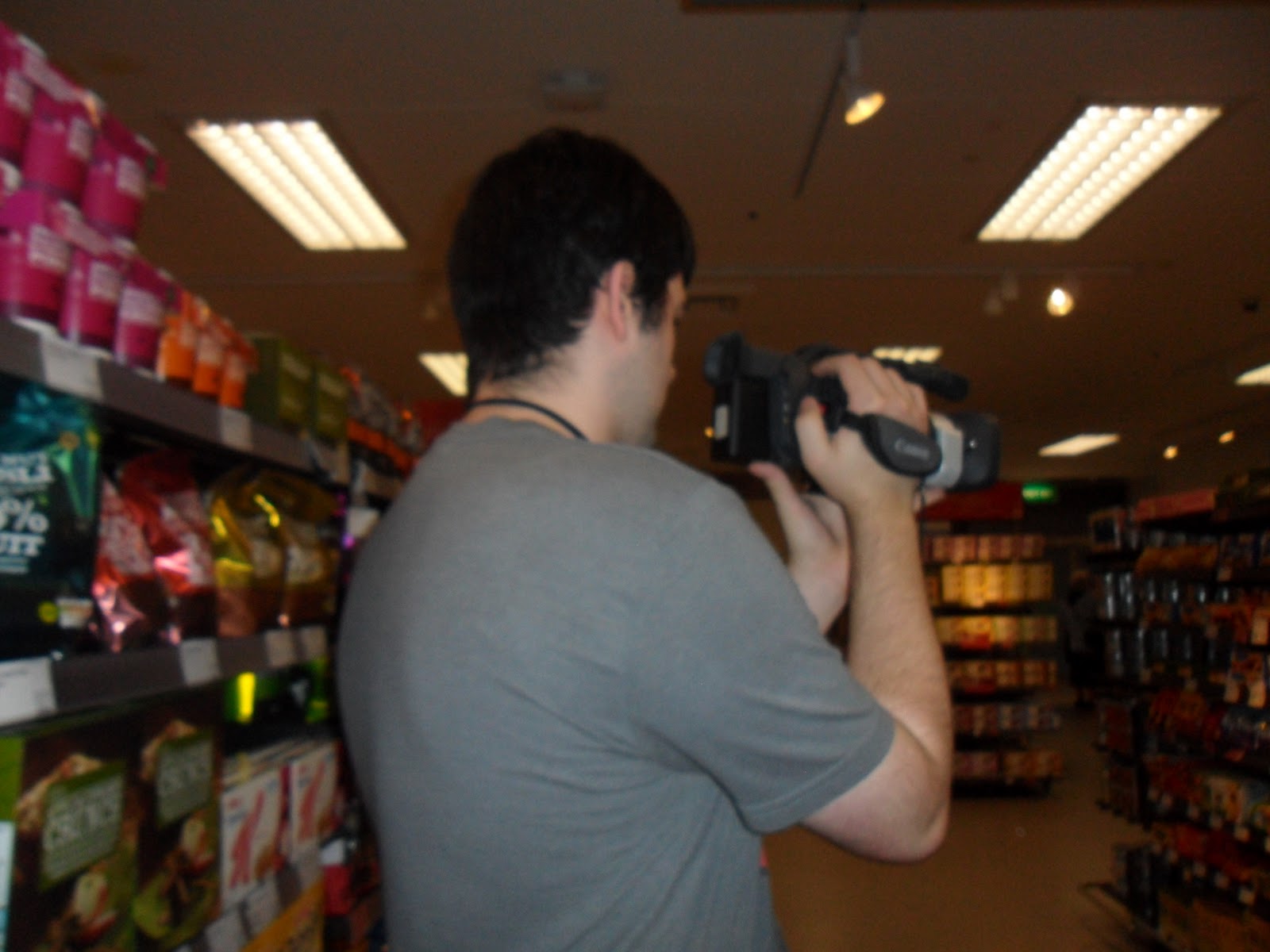
Sunday 23rd OctoberToday, Olivia and I went to the town centre to film some scheduled interviews with Greggs , Marks and Spencer’s, Millie’s Cookies and ASDA. However, the day proved to be less than successful. When we arrived at the town centre, we went to Greggs the bakers and asked if we could film some of their products for cut away shots and perhaps have an interview with one of their members of staff. They were cooperative and allowed us to shoot products, and took us to the back of the store to film an interview. However, after spending twenty minutes setting up the camera, plugging in a microphone, attaching it to the member of staff and framing the shot of the staff to include relevant mise-en-scene, said staff member then decided she did not want to take part in the interview. No other member of staff wanted to take part in the interview, forcing us to pack up our equipment and go instead to Millie’s Cookies. There we spoke to staff member Catherine, who too was a media student and understood our circumstance. She agreed to allow us to shoot the Millie’s Cookies products for cutaways and agreed to take part in an interview. The interview was highly successful – or so we thought, as when we’d packed up our equipment we realised the microphone was not switched on.
As a result, we asked Catherine to kindly reshoot the interview, and she was again very helpful and agreed to do so. We then decided to shoot some vox pops. Although members of the public were reluctant to take part, we managed to get around a dozen shots asking what their favourite biscuit was, and also whether they believed the Jaffa Cake is a biscuit or cake. We then went to Marks and Spencer’s at 2:00, as instructed by the manageress, Louise. She told us that she could not authorise our filming to take place, therefore we had to leave and hope to have more success at ASDA.
Before asking a manager at ASDA, we managed to covertly film biscuits on the shelves in the store. Then we asked a manager if we could film an interview with a member of staff. They stated that all members of staff were busy, but after persistence changed her story and claimed she could not authorise it herself.
Monday 24th OctoberToday we looked back at our footagefrom yesterday and realised that we made an error with the framing on the 2nd time we filmed Millie’ Cookies. And as the first shoot, with perfect framing and Mise-en-scene’s sound was off, we will have to go back to Millie’s Cookies and ask for another interview. We also noticed that the interview, the other people in my group conducted with a Morrisons employee’s framing was also off, so we will have to re shoot that one. Other than that, we managed to capture all our cutaways today and even the Millie’s Cookie’s interview as we may be able to save the sound when we come to edit. Today we also rang Marks and Spencer’s and asked if we could shoot an interview there and film some cutaways. The manager Ben was very cooperative and agreed, on the basis we go tomorrow morning at 9am. I and Charlotte are going to do this.
Tuesday 25th October Today’s filming was successful. We managed to film several cutaways with the biscuit aisle and customer’s buying biscuits.
Margaret a shop floor assistant agreed to be interviewed and we filmed her in the biscuit aisle. She was cooperative and after shooting the interview we left for college to look at our footage. We captured the footage back at college and realised we can use it.
Thursday 27th OctoberToday we looked over footage that Olivia had filmed of an interview, with her mother (a home baker) and of a section of the opening montage. The footage was excellent and we captured it straight away.
Wednesday 2nd NovemberToday I and Olivia went back to Millie’s Cookies to film an interview with Catherine. Again. However this too proved to be unsuccessful as when we had set the camera with a suitable framing and mise-en-scen, we realised that the microphone we had been given was not working and so had to leave.
Friday 4th NovemberToday All three of us went back to Greggs to film an interview. Paul, an employee was more than helpful. We managed to frame him right and he answered all questions correctly so it will be easily when we come to edit our voices out of it. Charlotte will take the camera home and, hopefully, film some cutaways and an interview with her little brother also a home baker.
Monday 7th NovemberToday we captured more footage ad began to place it on the time line and began to get a semblance of order and how the narrative of our documentary will pan out. We also figured that we can in fact fix the interview with Millie’s Cookies so we will not need to re-shoot.
Tuesday 8th NovemberToday we looked at our interview from Greggs and it was fine, so we captured it. However the interview conducted with Charlotte’s brother cannot be used as he looks out of the frame throughout the interview. Charlotte has agreed to reshoot this interview. We placed the Greggs interview on the time line and began to further place the shots together. We also discussed going back to Morrison’s tomorrow to shoot an interview again.
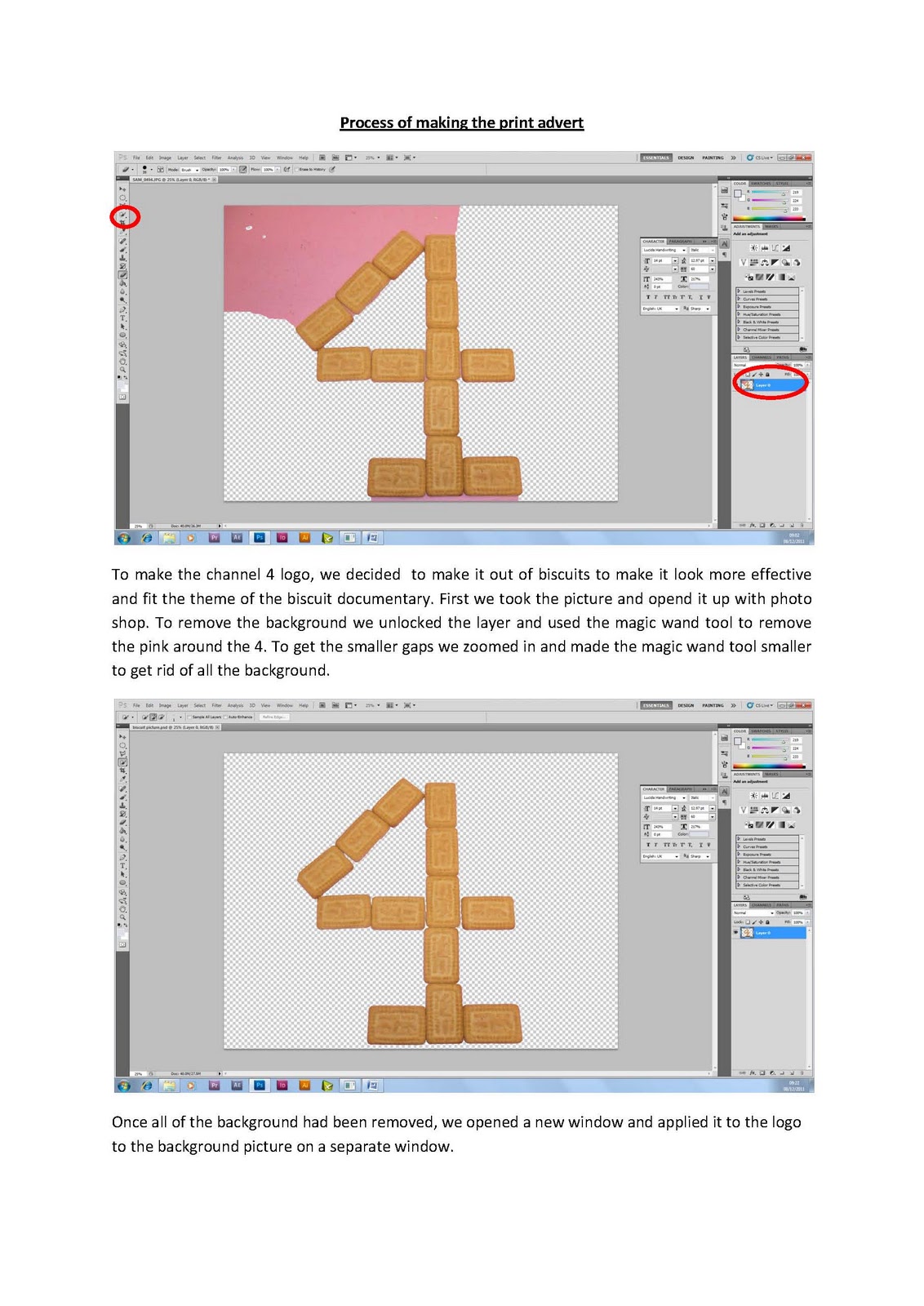
Thursday 17th OctoberToday we edited more of the documentary and placed the interviews in the order they will appear. We also filmed some footage for our opening montage, by placing biscuits on pink sugar paper, and then moving them, after pausing the camera, using stock frame animation. We will then remove the pink in post production and replace it with our documentary title, and add a music bed. We also found that the archive footage that we had downloaded was of poor quality so I will download it myself using the YouTube converter I have at home.
Friday 18th OctoberToday we managed to complete our opening montage by using the ‘chroma key’ tool on abode premiere to get rid of the pink so that when we place the opening title in place of it, the title will appear as the biscuits are being removed. We also made this title today by selecting a picture of the union Jack from the internet.
Monday 21st OctoberToday we placed more of the footage filmed on the line, however we noticed that we do not have enough footage so had to discuss what else we could film. Olivia agreed that she would film her mother baking biscuits and would bring the footage in tomorrow.
Tuesday 22nd OctoberOlivia brought in the footage of her mother (the home baker) baking biscuits. The footage Olivia filmed was fantastic and we can really use it to fill out the documentary. We captured the footage and found that we had a little too much, and so would have to be selective in what we chose toplace in the documentary. We chopped up certain parts and added a few cutaways of the home baker drinking tea and placing things in her oven.We decided that instead of having everything placed in the middle, we would cut up the home baker section throughout the documentary so not to bore the audience.
Tuesday 29th OctoberThis week we polished the footage that we had and managed to finally save the sound on the Millie’s Cookies interview, we also used footage of Jaffa Cakes that we filmed and used the motion tool to make it zoom in and out of the screen, by placing the Twilight Zone theme for comic effect. We also noticed that we needed more vox pops and so we must film them next week.
Tuesday 5th NovemberThis week we finally filmed more vox pops of the interviewee stating what there favourite biscuit is and whether they believed the Jaffa Cake was a cake or a biscuit. We added them to the documentary however we found that not all of them could be used as they moved too much and the framing was wring, and also we would run out of time, as we only have 5 minutes.
Tuesday 19th NovemberThis week we polished more ofour documentary and we are very close to finishing.We began work on our Radio Advert which I am in charge of, I started a new sequence and began to select audio from the original documentary and downloaded the same song used as a music bed.
This will be finished by next week. We also asked Kath Hope, a memeber of Priestley College staff agreed to help us by filming our voice over. We took her to the sound room and gave her a copy of the script and recorded her voice. This was sucesfull and Kath cooperated.
FVO
from Garibaldi’s to Bourbon’s, Cookies to Custard Cream’s, Britain loves a biscuit. We’ll do anything to get our hands on them, whether it’s grabbing a pack off the shelf or making our own. But why is Britain Bonkers for Biscuits?
Cue home baker
After Home Baker interviews
FVO
Everybody has their favourite Biscuit, But there’s one sneaky snack lurking in the Biscuit aisle that’s that has become some what of a mystery
Insert Scary Jaffa Cake twilight zone theme
After jaffa cake ad
FVO
The truth is, The Jaffa is a cake. McVities have stated that if they sold it as a biscuit we’d have to pay an astonishing 17.5% more VAT.
RADIO ADVERT
Insert music ‘how’d you do 3x’. Music fade created bed.
FVO
Britain loves Biscuits, but why are they so popular? Why have we fallen head over heels for the Garibaldi?
Insert vox pops from opening of documentary
Vox Pop
My favourite biscuit is a McVities chocolate digestive
Vox Pop
Bourbon
Vox Pop
Custard Cream
Vox Pop
Probably an Oreo
Vox Pop
Chocolate Hobnobs
FVO
We’ll do anything to get our hands on them, whether its grabbing a pack of the shelves or making our own
Female Home Baker
I make biscuits most weekends I find it really relaxing and enjoyable as well
Male Home Baker
The type of biscuits I make are chocolate chip cookies.
FVO
Relax with a cuppa, a Bourbon and watch Britain’s Biscuits. Wednesday the 20th December on Channel 4. Dunkin’ the Nation
The use of audio is taken from within the documentary ie. Vox Pops, answers to interviews and narration
The advert is easy to understand
It is short and simple
The adverts states the time and date the documentary is on and also the channel.
The advert’s narrator gives the advertising slogan
There is an underlying music bed which anchors meaning and is relevant to the topic.
Print Advert Codes and Conventions
The Channel 4 logo is found at the right of the page on all the adverts.
There is one central image
Usually a colour scheme
Limited wording, usually what the documentary is called, the slogan and when it is on
A website is included on some of the adverts.
Small or very little photo manipulation
Most have a banner around the wording to fit the colour scheme or make more legible.
In this advert, the central image is eye catching, and everything around it is blurred to make it clearer and it relates to the documentary title. The Channel 4 logo is on the right hand side and follows a colour scheme seen in the bottom left with the banner. Relevant information such as the date the documentary will air is also seen.
This advert also has a central eye-catching image that follows a blue colour scheme seen in the logo and the font. The Channel 4 logo is also typically in the left hand corner, also matching the font. Relevant information such as the time and date the documentary airs is also seen.
1) On a scale from 1- 5 how informative do you think our documentary is?
( 1 being not very 5 being very )
……….
2) On a scale of 1-5 how well do you think the editing in the documentary flows?
……….
3) On a scale of 1-5 how appropriate is voice over for the radio advert?
…………
4) On a scale from 1- 5 how good do you think the technical quality is? ( Sound, editing and continuity)
………..
5) On a scale from 1-5 how eye catching do you think our documentary is?
………
6) Do you think that our documentary obeys the conventions of a professional documentary? (rate on a scale of 1 -5 )
………
7) On a scale from 1- 5 how eye catching do you think our print advert is?
( 1 being not very 5 being very )
……….
8) On a scale of 1-5 how much do you think the radio advert flows?
………
9) On a scale of 1-5 how comparable is our print advert compared to professional channel 4 adverts?
………….
10) On a scale of 1-5 how much would you want to watch the documentary if you heard our radio advert?
……..
11) On a scale of 1-5 how much do you think radio advert informs enough about the documentary?
……….
12) On a scale of 1-5 how much would you change about the print advert ?
……..
13) On a scale of 1-5 how good do you think the quality of the radio advert is?
……..
14) On a scale of 1-5 how good is the quality of the narration on the voice over for the radio advert?
……..
15) On a scale of 1-5 how good is the quality of the print advert?
……..
By making this questionnaire and giving out to people that have seen our documentary I am able to see what people like the best and what we achieved the best in. The majority of the people that watched it gave higher results such as 4’s and 5’s so we will take this as positive feedback. The lowest result we got was a 3, which occurred on question 5. Although we do have a lot of footage in our documentary we should have used more interesting images and rather than using similar ones throughout which is why it might not be that eye catching.
The average answer for these questions are the following:
In Commonwealth English, it is a small and hard, often sweet, baked product that would be called either a cookie or a cracker in the United States and Canada.
The modern-day confusion in the English language around the word "biscuit" is created by its etymology.
The Middle French word bescuit is derived from the Latin words bis (twice) and coquere, coctus (to cook, cooked), and, hence, means "twice-cooked".[1] This is because biscuits were originally cooked in a twofold process: first baked, and then dried out in a slow oven.[2] Hence:
This term was then adapted into English in the 14th century during the Middle Ages, in the Middle English word bisquite, to represent a hard, twice-baked product.[3]
However, the Dutch language from around 1703 had adopted the word koekje, a language diminutive of cake, to have a similar meaning for a similar hard, baked product.[4] This may be related[citation needed] to the Russian or Ukrainian translation, where "biscuit" has come to mean "sponge cake".
The difference between the secondary Dutch word and that of Latin origin is that, whereas the koekje is a cake that rises during baking, the biscuit, which has no raising agent, in general does not (see gingerbread/ginger biscuit), except for the expansion of heated air during baking.[citation needed]
When peoples from Europe began to emigrate to the United States, the two words and their "same but different" meanings began to clash. After the American War of Independence against the British, the word cookie became the word of choice to mean a hard, twice-baked product.[citation needed]
Further confusion has been added by the adoption of the word biscuit for a small leavened bread popular in the United States.
Today, according to American English dictionaryMerriam-Webster:
A cookie is a "small flat or slightly raised cake".[4]
A biscuit is "any of various hard or crisp dry baked product" similar to the American English terms cracker or cookie.[3]
A biscuit can also mean "a small quick bread made from dough that has been rolled out and cut or dropped from a spoon".[3]
Today, throughout most of the world, the term biscuit still means a hard, crisp, brittle bread, except in the United States, where it now denotes a softer bread product baked only once. In modern Italian usage, the term biscotto is used to refer to any type of hard twice-baked biscuit, and not only to the cantuccini as in the past.
The need for nutritious, easy-to-store, easy-to-carry, and long-lasting foods on long journeys, in particular at sea, was initially solved by taking live food along with a butcher/cook. However, this took up additional space on what were either horse-powered treks or small ships, reducing the time of travel before additional food was required. This resulted in early armies' adopting the style of hunter-foraging.
The introduction of the baking of processed cereals including the creation of flour provided a more reliable source of food. Egyptian sailors carried a flat, brittle loaf of millet bread called dhourra cake, while the Romans had a biscuit called buccellum.[5] Roman cookbook Apicius describes:
“
a thick paste of fine wheat flour was boiled and spread out on a plate. When it had dried and hardened, it was cut up and then fried until crisp, then served with honey and pepper.
”
Many early physicians believed most medicinal problems were associated with digestion. Hence, for both sustenance and avoidance of illness, a daily consumption of a biscuit was considered good for health.
Hard biscuits soften as they age. To solve this problem early bakers attempted to create the hardest biscuit possible. Because it is so hard and dry, if properly stored and transported, navies' hardtack will survive rough handling and high temperature. Baked hard, it can be kept without spoiling for years as long as it is kept dry. For long voyages, hardtack was baked four times, rather than the more common two, and prepared six months before sailing.[6] To soften hardtack for eating, it was often dunked in brine, coffee, or some other liquid or cooked into a skillet meal.
The more refined captain's biscuit was made with finer flour.
At the time of the Spanish Armada in 1588, the daily allowance on board a Royal Navy ship was one pound of biscuit plus one gallon of beer. Samuel Pepys in 1667 first regularised naval victualling with varied and nutritious rations. Royal Navy hardtack during Queen Victoria's reign was made by machine at the Royal Clarence Victualling Yard at Gosport, Hampshire, stamped with the Queen's mark and the number of the oven in which they were baked. Biscuits remained an important part of the Royal Navy sailor’s diet until the introduction of canned foods. Canned meat was first marketed in 1814; preserved beef in tins was officially added to Royal Navy rations in 1847.[5]
Early biscuits were hard, dry, and unsweetened. They were most often cooked after bread, in a cooling bakers' oven; they were a cheap form of sustenance for the poor.
By the seventh century AD, cooks of the Persian empire had learnt from their forebears the secrets of lightening and enriching bread-based mixtures with eggs, butter, and cream, and sweetening them with fruit and honey.[7] One of the earliest spiced biscuits was gingerbread, in French pain d'épices, meaning "spice bread", brought to Europe in 992 by the Armenian monk Grégoire de Nicopolis. He left Nicopolis Pompeii, in Lesser Armenia to live in Bondaroy, France, near the town of Pithiviers. He stayed there for seven years, and taught French priests and Christians how to cook gingerbread.[8][9][10] This was originally a dense, treaclely (molasses-based) spice cake or bread. As it was so expensive to make, early ginger biscuits were a cheap form of using up the leftover bread mix.
With the combination of the Musliminvasion of the Iberian Peninsula, and then the Crusades developing the spice trade, the cooking techniques and ingredients of Arabia spread into Northern Europe.[7] By mediaeval times, biscuits were made from a sweetened, spiced paste of breadcrumbs and then baked (e.g., gingerbread), or from cooked bread enriched with sugar and spices and then baked again.[11]King Richard I of England, (aka Richard the Lionheart) left for the Third Crusade (1189–92) with "biskit of muslin", which was a mixed corn compound of barley, rye, and beanflour.[5]
As the making and quality of bread had been controlled to this point, so were the skills of biscuit making through the Craft Guilds.[7] As the supply of sugar began, and the refinement and supply of flour increased, so did the ability to sample more leisurely foodstuffs, including sweet biscuits. Early references from the Vadstena monastery show how the Swedish nuns were baking gingerbread to ease digestion in 1444.[12] The first documented trade of gingerbread biscuits dates to the 16th century, where they were sold in monastery pharmacies and town square farmers markets. Gingerbread became widely available in the 18th century. The British biscuit firms of Carrs, Huntley & Palmer, and Crawfords were all established by 1850.[13]
Hence, it is of no surprise that, often together with local farm produce of meat and cheese, many regions of the world have their own distinct style of biscuit, so old is this form of food.
Biscuits today can be savoury or sweet, but most are small at around 2 inches (5.1 cm) in diameter, and flat. The term biscuit also applies to sandwich-type biscuits, wherein a layer of cream or icing is sandwiched between two biscuits, such as the custard cream. European biscuits tend to be more sugary in consistency, and often creative in design though higher in calories, whereas the standard British biscuit is strong and stable (as opposed to crumbly) yet slightly blander (and typically cheaper compared to the European standard), designed perhaps for the tradition of "dunking" in cups of tea; hence preventing the collapse of the biscuit and ruining of the beverage.[citation needed]
Dunking a biscuit
Sweet biscuits are commonly eaten as a snack food, and are, in general, made with wheat flour or oats, and sweetened with sugar or honey. Varieties may contain chocolate, fruit, jam, nuts, or even be used to sandwich other fillings. There is usually a dedicated section for sweet biscuits in most European supermarkets.
In Britain, the digestive biscuit and rich tea have a strong cultural identity as the traditional accompaniment to a cup of tea, and are regularly eaten as such. Many tea drinkers "dunk" their biscuits in tea, allowing them to absorb liquid and soften slightly before consumption.
Savoury biscuits or crackers (such as cream crackers, water biscuits, oatcakes, or crisp breads) are usually plainer and commonly eaten with cheese following a meal. A large variety of savoury biscuits also contain additional ingredients for flavour or texture, such as poppy seeds, onion or onion seeds, cheese (such as cheese melts), and olives. Savoury biscuits also usually have a dedicated section in most European supermarkets, often in the same aisle as sweet biscuits. The exception to savoury biscuits is the sweetmeal digestive known as the "Hovis biscuit", which, although slightly sweet, is still classified as a cheese biscuit.
In general, Australians, South Africans, New Zealanders, Indians, Pakistanis, Sri Lankans, Singaporeans, and the Irish use the British meaning of "biscuit" (colloquially referred to as a "bickie") for the sweet biscuit. In Canada, the terms biscuit and cookie are used interchangeably, depending on the region, with biscuits usually referring to hard, sweet biscuits (i.e. digestives, Nice, Bourbon creams) and cookies for soft baked goods (i.e. chocolate chip cookies). Two famous Australasian biscuit varieties are the ANZAC biscuit and the Tim Tam. This sense is at the root of the name of the United States' most prominent maker of cookies and crackers, the National Biscuit Company, now called Nabisco.
History of Biscuits - Britannia
Sweet or salty. Soft or crunchy. Simple or exotic. Everybody loves munching on biscuits, but do they know how biscuits began?
The history of biscuits can be traced back to a recipe created by the Roman chef Apicius, in which "a thick paste of fine wheat flour was boiled and spread out on a plate. When it had dried and hardened it was cut up and then fried until crisp, then served with honey and pepper."
The word 'Biscuit' is derived from the Latin words 'Bis' (meaning 'twice') and 'Coctus' (meaning cooked or baked). The word 'Biscotti' is also the generic term for cookies in Italian. Back then, biscuits were unleavened, hard and thin wafers which, because of their low water content, were ideal food to store.
As people started to explore the globe, biscuits became the ideal travelling food since they stayed fresh for long periods. The seafaring age, thus, witnessed the boom of biscuits when these were sealed in airtight containers to last for months at a time. Hard track biscuits (earliest version of the biscotti and present-day crackers) were part of the staple diet of English and American sailors for many centuries. In fact, the countries which led this seafaring charge, such as those in Western Europe, are the ones where biscuits are most popular even today. Biscotti is said to have been a favourite of Christopher Columbus who discovered America!
Making good biscuits is quite an art, and history bears testimony to that. During the 17th and 18th Centuries in Europe, baking was a carefully controlled profession, managed through a series of 'guilds' or professional associations. To become a baker, one had to complete years of apprenticeship - working through the ranks of apprentice, journeyman, and finally master baker. Not only this, the amount and quality of biscuits baked were also carefully monitored.
The English, Scotch and Dutch immigrants originally brought the first cookies to the United States and they were called teacakes. They were often flavoured with nothing more than the finest butter, sometimes with the addition of a few drops of rose water. Cookies in America were also called by such names as "jumbles", "plunkets" and "cry babies".
As technology improved during the Industrial Revolution in the 19th century, the price of sugar and flour dropped. Chemical leavening agents, such as baking soda, became available and a profusion of cookie recipes occurred. This led to the development of manufactured cookies.
Interestingly, as time has passed and despite more varieties becoming available, the essential ingredients of biscuits haven't changed - like 'soft' wheat flour (which contains less protein than the flour used to bake bread) sugar, and fats, such as butter and oil. Today, though they are known by different names the world over, people agree on one thing - nothing beats the biscuit!
Some interesting facts on the origin of other forms of biscuits:
The recipe for oval shaped cookies (that are also known as boudoir biscuits, sponge biscuits, sponge fingers, Naples biscuits and Savoy biscuits) has changed little in 900 years and dates back to the house of Savoy in the 11th century France. Peter the Great of Russia seems to have enjoyed an oval-shaped cookie called "lady fingers" when visiting Louis XV of France.
The macaroon - a small round cookie with crisp crust and a soft interior - seems to have originated in an Italian monastery in 1792 during the French Revolution.
SPRING-uhr-lee, have been traditional Christmas cookies in Austria and Bavaria for centuries. They are made from a simple egg, flour and sugar dough and are usually rectangular in shape. These cookies are made with a leavening agent called ammonium carbonate and baking ammonia.
The inspiration for fortune cookies dates back to the 12th and 13th Centuries, when Chinese soldiers slipped rice paper messages into moon cakes to help co-ordinate their defence against Mongolian invaders.
History
Fox's Biscuits was founded in 1853 by Michael Spedding, who opened a small confectionery shop in the centre of Batley. One of the first biscuits developed was Brandy Snap. In 1864 the business moved to new premises, a bakehouse next door to Michael Spedding's home. Michael Spedding retired in 1897 and the business passed to his son-in-law, Fred Ellis Fox.
In 1927 the business transferred to new larger premises on the outskirts of Batley, the present site. By now Michael Spedding Fox and Alfred Henry Fox had joined their father in the company. Working closely together, they extended the product range to include top quality biscuits as well as the original brandy snaps.
In 1960, the Company's name was changed to Fox's Biscuits, and registered as a public limited company. In 1966 the factory in Kirkham, Lancashire was acquired.
In the mid 1970s, Fox's needed to expand the business. This needed substantial capital investment, which came from the partnership between Fox's and the then milk marketing giant, Northern Dairies. Northern Dairies, through its acquisition of a number of other companies in a similar position to Fox, became the Parent Company, Northern Foods.
In 2004 Elkes Biscuits, based in Uttoxeter, which was also part of the Northern Foods group, became part of Fox's biscuits and our third manufacturing site.
UB’s products are available through many retail outlets. UB works closely with its retail customers by offering them advice on merchandising as well as consumer insight into relevant product categories. Crisps and snacks
The total Bagged Snacks market is currently worth £2bn and continues to grow. The UB portfolio is responsible for 17% of total sales and includes top performing brands like McCoys, Hula Hoops, Mini Cheddars and KP, which customers expect to find in-store. When customers are buying bagged snacks, they will either be looking for a handypack to eat there and then, a bigger multipack to take home and enjoy later or perhaps use as part of a balanced packed lunch. UB can provide category advice on how to maximise sales through getting the right range, the right layout and the right location in-store.
Biscuits
The total UK Biscuits market is worth £2bn. The UB biscuits portfolio is responsible for more than 30% of total biscuit sales and includes top performing brands like the McVitie's range and McVitie's Jaffa Cakes which customers look for on the biscuits fixture. UB can provide category advice on how to maximise sales through getting the right range, the right layout and the right location in-store.
Mirror.co.uk top ten: Great British biscuits to beat the Oreo Invasion
In light of the Oreo invasion and its threat to Britain’s tea drinking, biscuit-dunking culture, here’s ten examples of why British biscuits are the best in the world. Chocolate DigestiveIt’s our biggest-selling biscuit by a mile, and as a nation we eat 52 of them every second. The Chocolate Digestive is the chocolate biscuit which all others look to. The dark chocolate ones have their own band of fiercely loyal followers who pour scorn on the milk chocolate version, so watch out for that.
Hobnob
This oaty biscuit first hit British tins in the 1980s and shot to overnight success, rapidly becoming one of the nation’s favourites. Peter Kay’s famous Hobnob dunking routine has just added to its legendary status.
Custard Cream
The timeless Custard Cream, with its charming swirly-patterned top, has been with us since Victorian times but is still a huge favourite today. Split them apart to get at the cream or just pop them in them in whole.
Bourbon
A cocoa laden yin to the Custard Cream’s yang. With sleeker lines than its custardy friend it lends itself to dunking. Look for the regulation ten holes and those little grains of sugar baked into the top.
Advertisement - article continues below »
Tunnocks Wafer
Perhaps Scotland's most important export after North Sea oil. The distinctive red and gold wrapper and chewy caramel and chocolate wafer speak to us from simpler days gone by. The Tunnocks Chocolate Caramel Wafer, to give its proper name, proudly boasts that it sells four million a week. Jaffa Cake
Strictly a cake rather than a biscuit, this is of little concern to the millions of us who regularly pop them in our trollies. Again a terrific one for either nibbling and dismantling into its parts or wading into quick fire. Gingernut
A biscuit with a bit of fight in it, the gingernut is both spicy and hard. Tame them with a hot cuppa, but keep them separate from the other biscuits or they’ll turn gingery too!
Shortbread fingers
The refined choice for many, the shortbread finger likes to imagine itself nestled in the saucer of a bone china tea cup.. probably at a croquet match. Given the amount sold it’s a fair bet a good few of them meet their end in a mug of builders' tea too. Fig RollCurrently beset by a Turkish fig supply crisis, the fig roll is a bit of a one-off. Loved by most and loathed by some, it's one of the few biscuits to go hard when it turns stale. Malted Milk
Very tasty, with bonus three dimensional cows on top. Careful nibbling can result in complete cow-ectomies.
Biscuit sales soar as recession drives people to 'comfort food'
Biscuit sales in Britain have soared by more than 20% over the last five years as people turned to comfort food during the recession.
Sweetmeal or wholemeal biscuits are in at fourth place and tea biscuits take fifth placePhoto: PA
Sales of biscuits, cookies and crackers have increased 22% since 2005 to reach £2.2billion in 2010.
More than half the nation (54 per cent) admit enjoying a biscuit with their tea or coffee, according to new research by market analysts Mintel.
Biscuits are seen as a traditional "comfort food", which people turn to as a cheap treat when more expensive relaxation, such as going to the cinema, is unaffordable.
And the overall UK biscuit market is set to continue to grow, as forecasts precict sales rising a further 15% to £2.6billion by 2015.
The latest figures show that 89% of 45- to 54-year-olds enjoy tea with a biscuit.
However, they are less of a temptation to 16- to 24-year-olds where biscuit eating falls to 80%.
Amy Lloyd, senior food and drink analyst at Mintel, said: "The UK biscuit industry has benefited from consumers reaching for the biscuit barrel throughout the recession, although rising commodity costs and an inability to appeal to a younger and more discerning consumer base are threatening the market.
"The ritualistic nature of eating biscuits with a hot drink appeals to consumers, demonstrating how ingrained this occasion is within British culture but emphasising the need for the biscuit category to expand beyond the tea-drinking audience."
Half-coated biscuits - such as chocolate digestives - and individually wrapped varieties are in joint first position as the nation's favourite sweet biscuit - more than one in two have brought one or other of these in the past year.
The next most popular biscuits are cookies - such as chocolate chip cookies - while cream biscuits - such as Custard Creams - take third position.
Sweetmeal or wholemeal biscuits are in at fourth place and tea biscuits take fifth place.
Within the market, "healthier" biscuits - which include lower fat and sugar varieties - dominate sector sales (£468 million), accounting for as many as a quarter of all sweet biscuits sales and increasing 16% between 2008 and 2010.
Biscuit making process
Automated Biscuit making process involves four basic stages namely mixing , forming ,baking and packing . Basic ingredients for biscuit manufacturing
Flour , fat and sugar and other additives like flavours ,salts and ammonium and sodium bicarbontes. Bakery equipments required for biscuit manufacturing
MIXING: This is a process where all ingredients are put together in right proportion for dough formation.These ingredient are then fed into Mixers where mixing is done and dough is prepared for molding .Major ingredients are flour , fat ,sugar and others as per the product one would like to have.Dough temperatures play important role in biscuit manufacturing .Next important factor is mixing time . Mixing time depends upon flour characteristics.Normally mixing time is between 10- 15 min and is performed in two or thres stages with different mixing speed .
MOULDING: In this section we laminate the dough into sheet which then passes down to gauge rollers and sheet thickness is achieved for cutting . Here we have a cutter or a moulder as per the variety where one gets the shape and sizes of biscuits .Moulder /cutter speed again depends on different variety of biscuit.Moulders are used for short dough type of biscuit and cutters are used for sheet variety or hard dough .
BAKING: This is the area where we pass these moulded wet biscuit into baking oven .The biscuits are baked on desired temperature s.Various type of heating are available now days as per the convenience and cost .Different type ovens are available like direct fired , indirect fired and hybrid ovens .Heating of biscuit is done by conduction , convection and radiation inside the oven .Dampers are provided to control moisture inside the oven ssection . Different heating profiles are maintain for different varities of biscuit . Normally ovens are classified as 4 zone , 5 zone or 6zone ovens where length varies from 40 mtr to 80 mtrs . Biscuits are carried on wire mesh band in oven . Baking time are different
COOLING: These baked biscuits are then passed on to cooling conveyors for natural cooling prior to packing .The temperatures are brought down to room temperatures .The length of conveyor is sometimes 300 - 400 ft . Cooling conveors can be of two deck or 3 deck type as per space availability . Natural cooling is prefered over forced cooling as it maintains the texture quality of biscuit .
PACKING: These biscuit are then stacked and fed into packing machine for packing. Different packing material are available for packing of these biscuit in different packs .slug packs , pouch pack or family packs etc. These packs are then put into secondary packaging like cartons to be transported to retailers.Packing material used for biscuit packaging are BOPP ,Laminates ( pearlised or metallised ) ,Pouches .
Types of biscuit
Various types of biscuit are available in market eg Plain glucose , Cracker , Digestive , Cream Sanwich ,Wafer , Enrobed and biscuits with Filling






 /ˈbɪskɨt/) is a baked, edible, and commonly flour-based product. The term is used to apply to two distinctly different products in North America and the Commonwealth Nations.


 Comment


